Designing Within Incentive Systems
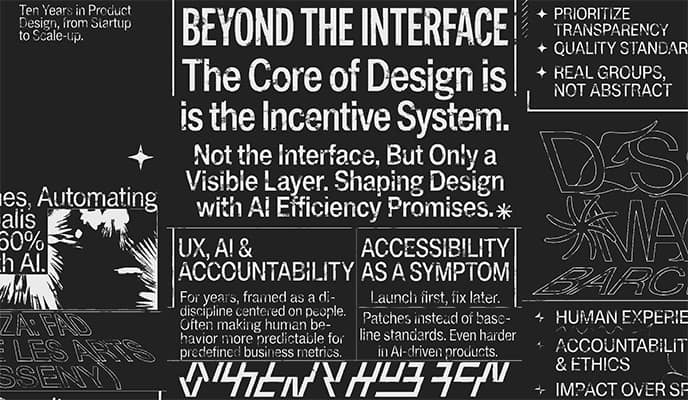
Beyond the interface
For more than a decade, I’ve worked as a product designer in Barcelona, leading design teams across startups, platforms, and scale‑ups that sell themselves as useful solutions for everyday life. After ten years in product design, I’m clear that the interface is not the core of the practice, but only one of its visible layers.
What really shapes design is the incentive system behind it: growth, metrics, profitability, and, in the 2026 context, the extreme efficiency that AI promises. Within that same system live accessibility, the way we treat people with less visibility, and how design teams are managed, even when work becomes more remote, more fragmented, and more dependent on automated tools.
The issue is not only what we design, but what it’s optimized for, who defines success, and who gets left out when everything is measured by speed, efficiency, conversion, or “60% faster with AI”.
UX, AI, and accountability
For years, UX has been framed as a discipline centered on people. In practice, it often works as a layer that makes human behavior more predictable inside business metrics that were defined long before design came into the room.
That imbalance becomes more obvious when organizations can automate a significant share of decisions that used to be in the hands of product, research, and design teams. When a design team accepts that a product can, in theory, be “60% faster or cheaper” thanks to AI, the conversation shifts away from quality and toward accountability.
This is not about demonizing AI. It is about acknowledging that AI is not neutral. If the system it sits in is built to maximize engagement, clicks, or revenue, AI amplifies exactly that. And everything that does not fit easily into a clear metric —context, wellbeing, nuance, accessibility— risks being pushed aside.
Accessibility as a symptom of the system
Accessibility is one of the clearest signals of how these incentives work. It is often addressed late, when legal compliance, reputational risk, or public‑facing sensitivity come into play.
That creates a familiar pattern: launch first, fix later, and if there is not enough pressure, never fix it at all. Accessibility ends up working as a patch or an extra, instead of being treated as a baseline quality requirement.
In AI‑driven products, the issue gets even more delicate. Interfaces that change based on behavior, opaque recommendations, or dynamically generated flows can make things harder for people who are already excluded from so‑called “mainstream” scenarios. This is not only a technical issue. It is a prioritization issue that tends to be taken implicitly, often without explicit recognition.
From abstract users to real groups
A common trap in contemporary design is talking about people in the abstract. “The user” is often a comfortable stereotype: generic, tidy, contradiction‑free, perfect for a slide deck or dashboard.
I prefer to think in specific groups. People with disabilities. Older adults. People on limited incomes. Distributed teams. Freelancers trapped in platform dynamics. People who do not experience the product as a promise, but as a dependency, a barrier, or a constant negotiation.
That shift matters because it moves design beyond performative empathy. Quick research, lightweight interviews, or workshops that only validate pre‑decided ideas are not enough. Designing better means recognizing who carries the cost of our decisions from the very beginning.
AI, the 60%, and leading design teams
In many cases, a company can automate 60% of what a design, research, or product team used to do with AI: wireframes, copy, insight gathering, interface recommendations, or even full flows generated from a prompt. That speeds up the process, but turns decisions that used to be deliberate, discussed, and nuanced into outputs from a model trained around very specific goals.
And in that leap, it often becomes easier to forget to ask “for whom we are doing this, and who is left out”.
The 60% is not just a round number; it is a metaphor for how AI can become an efficiency tool without revisiting the quality of the underlying decisions. The more you delegate to AI, the more you need people with experience—product managers, designers, researchers, leads—to explain why something is being optimized, who is being left out, and what is being lost in the process.
From my role as a design lead, managing ICs in this environment means:
- Ensuring that AI is not used to quietly “lower the bar” of design, but as a tool that articulates with quality, context, and accountability.
- Reminding the team that design is not just about speed, but about impact.
- Thinking about how design work is measured when a significant part of the process becomes invisible, because it lives inside a model or a prompt.
- Leaving space for debate around priorities, accessibility, and real groups, even when the incentive system mainly tracks business metrics.
Designing with limits, but with clarity
There is no need to turn this into a grand manifesto. There is also no need to pretend that a designer, a lead, or a team can rewrite the system alone. But it is possible to work with more intention, even from within it.
That means making some fairly concrete choices:
- Prioritize transparency when automation makes a product more opaque.
- Treat accessibility as a quality standard, not a secondary checklist.
- Think less in terms of abstract audiences and more in terms of real groups affected by the product.
- Question when that “60% faster” output is really worth the loss of context and control.
- Acknowledge that design is not only a matter of aesthetics, but of power, priorities, and impact.
A less innocent practice
Design is not neutral, but it does not need to become cynical either. The alternative is to work with greater awareness of the systems, incentives, and real people behind every product decision.