Automating SEM asset creation and optimization with AI and internal tools
Introduction
In digital marketing teams — especially in SEM — there’s a recurring problem that rarely gets solved from a product perspective: managing and producing visual assets.
Across multiple projects, I noticed a clear pattern: a significant amount of time is spent on repetitive image-related tasks.
- Optimizing file sizes to meet platform requirements
- Finding high-quality stock images consistent with a campaign
- Adapting formats and aspect ratios for different placements
- Producing multiple creative variations
These tasks aren’t strategic, but they are critical for execution.
Teams don’t need more creative tools. They need to remove friction from repetitive workflows that slow execution down.
The opportunity
I identified a clear business need: reducing operational time in asset management and increasing campaign launch speed. The issue wasn’t a lack of resources — it was a lack of tools aligned with real, daily workflows.
So I decided to build three focused tools, each addressing a specific friction point in the process.
1. Bulk image optimization
👉 image-reduce-resize.vercel.app
The first problem: heavy images in production. This directly impacts web performance, page load times, and campaign efficiency.
Solution
A tool where users can paste a batch of image URLs, set a target size (e.g., under 100kb) and process them automatically.
Result
- Massive file size reduction without manual intervention.
- High-speed batch optimization in seconds.
- No need for complex external software for tactical tasks.
2. Stock image API downloader
👉 image-api-downloader.vercel.app
The second problem: the friction of searching for and downloading assets one by one across multiple stock platforms.
Solution
A centralized tool that connects to stock library APIs, enabling thematic searches and batch downloads in a single workflow.
Result
- Drastic time savings in asset discovery.
- Improved visual consistency across complex campaigns.
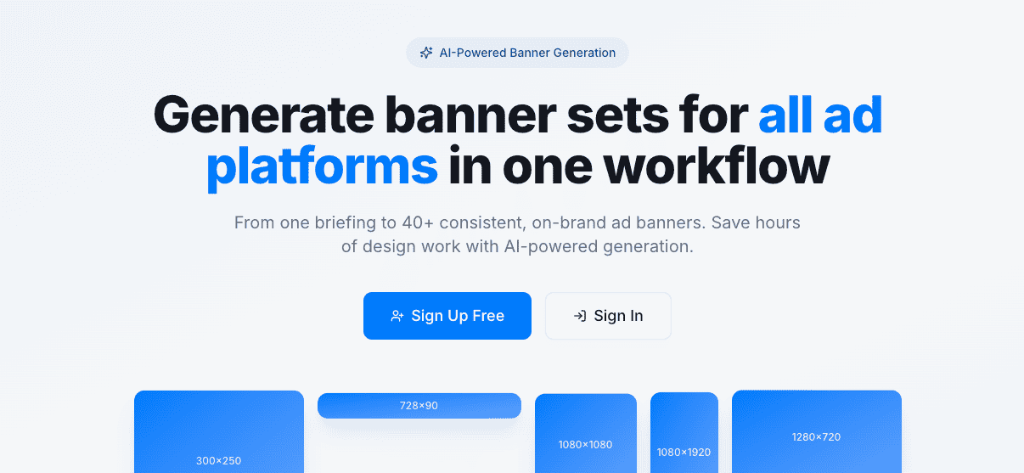
3. AI-powered asset generation (BannerMagic)
The third and perhaps most costly problem: adapting creatives to the myriad of formats required by ad platforms (Display, Social, etc.).
Solution
An AI-driven tool that generates image sets automatically, adapting aspect ratios based on the objective while maintaining aesthetic coherence.
Result
- Full asset sets produced in minutes.
- Infinite creative scalability.
- Reduced dependency on manual design processes for tactical execution.
Key decisions
During development, I prioritized strategic utility over feature bloat:
- Focused tools over generic platforms: Each tool solves a specific, real-world pain point.
- Speed over perfection: Designed to be fast, functional, and zero-friction.
- Applied AI over hype: Practical use of AI models for meaningful content generation and adaptation.
- Workflows over features: The true value emerges when these tools integrate into the team’s daily flow.
Learnings
This project reinforced several key ideas about strategic design operations:
- The biggest business opportunities are often hidden in “invisible” processes.
- Automating internal workflows can have a larger impact than launching new external features.
- AI is truly valuable when it removes repetitive burden, allowing teams to focus on strategy.
- Design is also about optimizing operations.
Explore the tools
Try each tool and see how they connect into an optimized production workflow.
Closing
This case study isn’t about building a massive platform. It’s about something more vital: identifying real friction in a process and removing it with simple, effective tools. Because innovation often isn’t about adding more layers — it’s about removing the ones that slow you down.